After guiding 2,000 people, here’s the truth about ice baths…
…what the hype gets wrong and what actually works.
If you followed wellness trends over the last few years, you’d think ice baths were a magic bullet.
And if you look at Google Trends, the hype hit a fever pitch in early 2024.
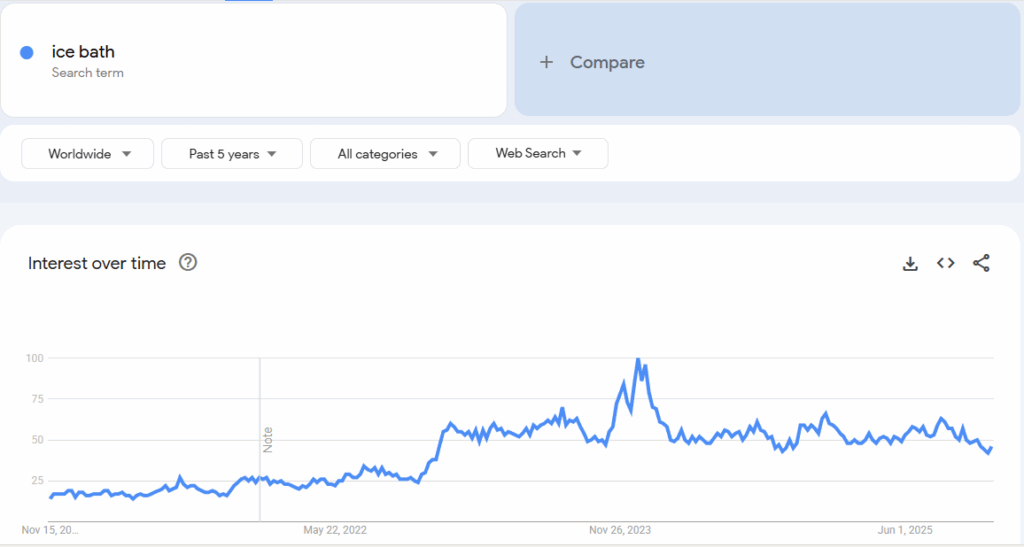
Now, the pendulum is swinging back.
Skeptical articles are popping up, questioning the benefits and even warning entire groups of people away.
As someone who has personally guided nearly 2,000 people through breathwork and ice bath experiences here in Chiang Mai, I can tell you:
both the hype and the skepticism are wrong.
The truth isn’t in the extremes. It’s in a simple “common sense” rule that the wellness world seems to have forgotten:
The drug is in the dose.
I’ve seen this firsthand. I had a yogi friend, someone I considered a master of mind-body control, show up to one of my sessions. He admitted he’d overdone it with a 20-minute plunge on his own and now was afraid to even get in. He had, in his own words, “cold PTSD.”
He fell for the Instagram myth:
that “more is better.”
This article is the antidote to that. It’s the “common sense” guide to cold therapy, separating what’s hype from what actually works.
The 2 REAL Benefits the Hype Ignored
The media loves to talk about “muscle recovery,” but we’ll get to why that’s mostly a myth later. In my experience, the two most powerful and immediate benefits of cold therapy are energy and mental toughness.
1. The 2-Hour Energy Boost (The Science)
Forget your espresso. The single most reliable benefit of a cold plunge is the clean, powerful, non-caffeinated energy you get for hours afterward.
This isn’t just a “feeling.” It’s a massive biochemical response.
When your body hits that cold water, it’s a (safe) shock to your system. To protect you, your brain releases a flood of neurotransmitters. One study on immersion in 14°C (57°F) water found this response included a:
- 530% increase in noradrenaline (norepinephrine)
- 250% increase in dopamine
Noradrenaline is the “get up and go” hormone that boosts vigilance, focus, and alertness. Dopamine is the molecule of motivation and mood. Unlike other stimulants, this cold-induced rush provides a prolonged rise in dopamine that doesn’t come with a subsequent “crash.”
It is, quite simply, the most powerful natural pre-workout or pre-meeting tool I’ve ever found.
2. Training Your “Freak Out” Button (The Mental Gain)
This is the true secret of the ice bath. It’s not a “health” tool; it’s a mental toughness tool.
The second you get in the cold, your body’s survival-driven nervous system screams “FREAK OUT!” You gasp, your heart races, your muscles tense.
Your job is to not freak out.
By using your breath and your conscious mind, you are performing a “top-down” override. You are teaching your prefrontal cortex (your rational brain) to stay in control while your amygdala (your panic button) is going wild.
This is more than just a metaphor. The cold water on your face and body activates the vagus nerve, a core component of your “rest and digest” nervous system. By consciously breathing slowly, you are strengthening your vagal tone.
You are training your nervous system to handle stress effectively. That 3 minutes of “controlled panic” in the tub trains you to stay calm when you get that stressful email, when you’re stuck in traffic, or when life throws real chaos at you.
De-bunking the “All or Nothing” Myths
The “common sense” approach means ditching the “all or nothing” mentality. Let’s clear up the three biggest myths I see.
Myth 1: “More Cold is Better”
The “cold PTSD” story from my yogi friend is the perfect example of this myth’s danger. You do not need a tub full of ice to get the benefits.
Remember that study? The 530% noradrenaline boost?
That was at 15°C (around 60°F).
This is why I wrote my Ice Bath for Beginners guide. For most people, 15°C is the sweet spot. You get the full biochemical benefit without the risk of overdoing it. It’s also why I prefer ice baths over high-tech cryotherapy; you have more control, and it’s about the mental game, not just the extreme temperature.
Myth 2: “Cold Plunging Isn’t for Women”
This is a lazy and dangerous oversimplification. The real answer isn’t avoidance; it’s personalization.
It’s true that most research is on men. But new, women-focused research from experts like Dr. Stacy Sims shows that women’s physiology is simply different.
- Women tend to vasoconstrict (pull blood away from the skin) faster.
- Hormonal changes (especially during the luteal phase) can make women more sensitive to cold stress.
Forcing the “colder is better” model onto women can be too stressful, potentially elevating cortisol and disrupting hormones.
The “common sense” solution? Stick to the 15°C (59°F) range. At this “sweet spot,” women get all the positive benefits (dopamine, energy) without the negative stress. In fact, some research suggests that once adapted, women have a cold water advantage, relying less on shivering and more on efficient blood flow for a more sustainable response.
Myth 3: “It’s All About Muscle Recovery”
This is the most pervasive myth in the fitness world. Here’s the truth:
If your goal is to build muscle and strength, do NOT take an ice bath after your workout.
The “recovery” you feel is the blunting of inflammation. But that inflammatory response (anabolic signaling) is the very signal your body needs to adapt and grow stronger. Studies are clear: regular cold water immersion after strength training can blunt long-term gains in muscle mass and strength.
It’s only useful for short-term recovery (e.g., an athlete who has to compete again the next day).
The “common sense” (and science-backed) approach for adaptation? Use the cold BEFORE your workout. As I’ve detailed in The Ice Bath Edge, that pre-workout dopamine and noradrenaline hit gives you the energy and endurance to train harder, leading to better results.
How to Start: A “Common Sense” 3-Step Guide
Ready to try? This is a sample protocol for beginners.
- Step 1: The Setup (15°C is enough) Aim for 15°C (60°F). For many, a “cold” tap will get you close. Start with a 60-second timer.
- Step 2: The Breath (This is the real tool) You cannot control the cold without controlling your breath. The “cold shock” reflex will make you want to gasp and hyperventilate. Your job is to override this. The moment you get in, focus on long, slow exhales. This signals “safety” to your nervous system. You can see my full guide on Cold Plunge Breathing here.
- Step 3: The Time (Start with 60 seconds) That’s it. One minute. Get in, control your breath, and get out. You win. The goal is consistency, not duration.
The Truth You MUST Hear: You Don’t Need an Ice Bath
I’m going to say something my clients have heard me say before:
You don’t have to do ice baths to be healthy.
But you DO have to BREATHE.
The ice bath is just an (optional) “gym.”
Breathwork is the non-negotiable skill.
It’s the tool that controls your energy, your stress, and your health every second of every day.
You can’t go 3 minutes without breathing. You can go your whole life without an ice bath.
Frequently Asked Questions (FAQ)
- What’s the difference between an ice bath and a cold plunge? Honestly? Ice baths make for better Instagram photos. A “cold plunge” or “cold therapy” is any immersion. You don’t need floating ice to get the benefits—15°C is all you need.
- Can you get sick from an ice bath? As I’ve busted this myth before, the cold itself doesn’t make you sick. But overdoing it (too cold, too long) can be a massive stressor that taxes your system, potentially lowering your defenses. The “common sense” dose is safe.
- How long is too long for a beginner? Anyone experiencing extreme pain, discomfort or shivering for more than a minute should get out and slowly warm up. The “dose-response” for the key benefits (dopamine, noradrenaline) happens fast.
- Should I plunge before or after a workout? Before to build muscle and strength (for energy and endurance). After only if you need to reduce soreness for a competition the next day, and you don’t care about long-term adaptation.
The Bottom Line
The cold is a powerful teacher. It teaches you that a “stressor” can be a tool. It trains you to be calm under pressure.
But it demands respect. The “drug is in the dose,” and the “common sense” approach will always beat the “Instagram-hype” approach.
If you want to master the tool that controls 90% of your energy and focus, you have to master your breath.
I can show you how – starting with your 10-min ENERGY boost.